Hays Talent Talks 2026:
A day that sharpened the future of talent management like never before
On 26 February 2026, Hays gathered a select group of HR decision‑makers, executives and talent strategists at Hotel Van der Valk Mechelen for the very first edition of Hays Talent Talks.
The goal was clear: to create a day where insights, dialogue and future perspectives come together. A space where leaders can equip themselves for what is undeniably becoming a new era of work.
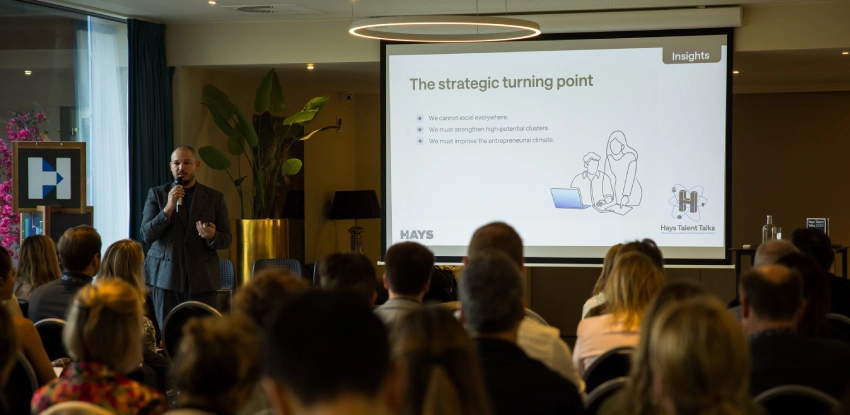
From geopolitical shifts to AI acceleration, from labour market paradoxes to the question of how we can place talent back at the centre: Talent Talks 2026 was not a conference, but a wake‑up call. The world is changing faster than organisations can keep up with and yet now is the moment to move forward.
What the speakers really said (and why it matters)
Hamid Hajjab – Insights Session: The K‑economy
Hamid, Enterprise Solutions Director at Hays, described how we are now living in a pronounced K‑economy: some sectors are growing faster than ever, while others are structurally under pressure. This creates a labour market where opportunities and constraints coexist, and where organisations can only move forward if they understand the reality they operate in.
“Companies must understand the reality they operate in: growth, stability or decline. If you don’t act consciously, things will inevitably go wrong.”
According to Hamid, everything starts with awareness. That insight determines which talent strategy will work and which pitfalls you must recognise. In a K‑economy, paradoxes are everywhere: employees expect autonomy while companies need agility; young starters want to join, while companies aren’t hiring them; and AI promises efficiency while simultaneously increasing pressure and uncertainty.
Jo Caudron – Keynote: F//ck The System

As an external strategist, Jo presented a brand‑new keynote based on his recent book “F//ck The System and Other Bad Ideas for the Future.” He dissected the often‑heard claim that Europe is exhausted: technologically irrelevant, stuck in regulation, and dependent on the U.S. According to Jo, that image is misleading.
Jo zoomed in on the geopolitical reality Europe faces today. He argued that the impact of geopolitical shifts: from Trump’s policies to the global repositioning of economic power, is still heavily underestimated. While we do feel a sense of urgency around AI, that same alertness is missing in other domains that are just as decisive for our future.
“Europe is not weak. Europe is at a crossroads. And those who dare to choose in the next ten years will help determine what the world will look like in 2040.”
Europe must grow up: become less dependent, more self‑reliant and better able to look beyond the issues of the day. This requires critical thinking, following global developments, and interpreting their long‑term consequences. His newest book offers a clear compass for those who want to go deeper, but his core message remained the same: this will not resolve itself. It requires conscious action from both companies and individuals.
Panel Discussion: Talent Strategies for 2026
The panel featuring Hamid Hajjab, Paul Verschueren and Céline Zintz, moderated by Jo Caudron, brought together three complementary perspectives on one central question: what can companies do today to strengthen their position?
Céline, Manager HR Business Partner at Verisure, was particularly clear: organisations must take ownership again and actively shape their workforce. This means identifying what talent they already have, which skills they will need in the future and, above all, listening to what candidates and employees need. According to her, that is where the biggest gap lies today. Investing in retaining your best people requires more than placing them in a role that suits your needs. It requires building a strong experience, enabling talent to grow and adapt.
Paul added a sharper warning: there is still too little sense of urgency across society and within companies. New technologies evolve exponentially, while organisations rise only linearly, making it increasingly difficult to keep pace. Those who ignore this acceleration will fall behind before they even realise it. The panel reached one clear conclusion: those who want to move forward must be aware of what is changing, dare to anticipate and choose action today.
Paul Verschueren – Technology and a European Momentum

According to Paul, Regional Director Flanders at Federgon, we are at a tipping point: organisations that do not consciously strive for a new peak will eventually slide into the valley. But that does not have to be a negative prospect. On the contrary, those who recognise the urgency of this evolution can move forward stronger.
By viewing technology and AI as tools that empower people, supporting employees in truly adopting those tools, and by allowing Europe to reclaim its position, we can actively shape that new peak.
A lot is already shifting under the radar, creating momentum. And that is exactly where the positive story lies: those who choose consciously today will not only remain relevant, but help determine where Europe, and their own organisation, will stand tomorrow.
What people missed if they weren’t there
Those who couldn’t attend missed a day where the paradoxes of our labour market were highlighted with unusual clarity, and urgency for the future was created without falling into panic.
The aim was to inspire action. Hamid captured it perfectly:
“The world of tomorrow will look different. Not maybe, but definitely. And if you don’t consciously choose how to respond, you are choosing as well… just wrongly.”
Conclusion: Talent Talks 2026 was not just an event, it was a starting point
This day made us realise organisations must:
- embrace technology with people at the centre
- take geopolitical and technological shifts seriously
- rethink leadership
- deploy and cherish talent strategically
Contact us
Want to know more about our services or are you looking for new employees? We are happy to contact you.
Follow us on social media